
To those living in the Northern Hemisphere, I bid Samhain’s blessings to all who celebrate! We are now halfway through autumn, and we grow ever nearer toward the darkest days of the year. Our thoughts turn inward to ready us for rest and reflection. Today, I share with you not only the history of this sabbat, but how I observe and celebrate it on my own path as a Khthonic Wiccan (which you can read about here).
History & Folklore
From Old Norse ‘jól’ meaning ‘feast’, Yule (pronounced ‘yool’) is one of the eight sabbats of the Wiccan Wheel of the Year which is inspired by the Germanic 12-day observation of the same name and the Anglo-Saxon Mōdraniht (‘Mothers’ Night’). As it occurs during the winter solstice – the time of the year in which the day is at its shortest and the night is at its longest – it is considered a Greater Sabbat, though this does not imply that it is any more important than the four Lesser Sabbats.
The origins of Yuletide traditions are greatly contested among scholars, with some suggesting the term only arose with the Christianization of Germany while others point to Odin’s epithet Jólnir (‘the Yule one’) as evidence to the contrary and draw connections to Winter Solstice observations surrounding the Wild Hunt. The former seems to be true in that case of many of the modern popular traditions surrounding Christmas, such as that of the Christmas tree, the myth of Santa Claus, and perhaps the Yule log.
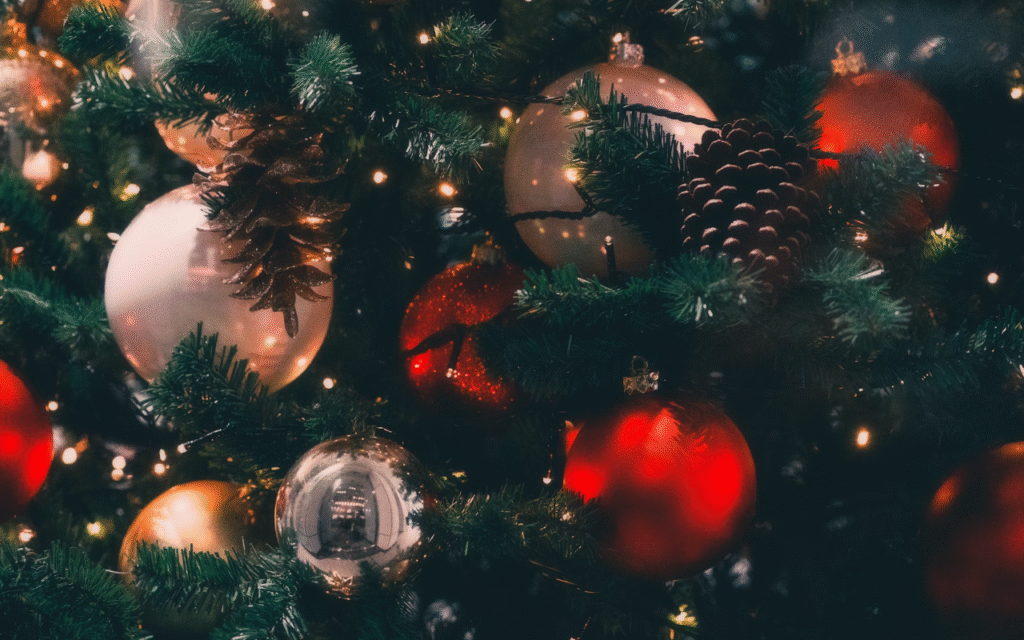
The origins of the Christmas tree are thought to have originated in the 16th century via Protestant Christian Martin Luther, who was said to have been the first to add lit candles to an evergreen tree. In 1539, German Lutherans continued this tradition by placing the first official Christmas tree in the Cathedral of Strasbourg. Finally, in 1576, we see the first firmly dated representation of Christmas being brought into private homes. The start of the tradition itself may have been connected to the tree of paradise – a fir tree decorated with apples (to represent the tree of knowledge) and round white wafers (to represent the Eucharist) – which appeared in medieval mystery plays commemorating the story of Adam and Eve.
The myth of Santa Claus can be traced back to the 17th century English personification of Christmas, Father Christmas. When the Puritans attempted to abolish Christmas by outlawing its customs, Royalists used the image of Father Christmas to represent the good old days of feasting and merrymaking. During the Victorian era, as observations became more family-oriented, the figure evolved into a mythological bringer of gifts, which, naturally, connected him to the Christian St. Nicholas (Sinterklaas in Dutch), the patron saint of children known for his tremendous generosity. Finally, the Santa Claus we know today evolved further into the jolly, round, North Pole bound figure riding a sleigh of eight magical reindeer at the hand of a great deal of 19th and 20th century American Christmas literature.
The origins of the Yule log are a bit muddier, as the first written evidence for this tradition can be found in Robert Herrick’s poetry from 1648. In Herrick’s works, it is referred to explicitly as a ‘Christmas log’ and was believed to bring prosperity. The first mention of the ‘Yule log’ came later in 1650, and it was only in the 18th century that historians began to theorize that the custom may have evolved from pre-Christian Germanic practices. These theories note that all countries which held the earliest accounts of Yule log traditions were once part of the Roman empire and a 6th century admonishment by St. Martin of Braga of Pagan practices still in play at the time which read: “To take notice of the Volcanes and of the Calends, to garnish to tables, to lay laurel, to enter with the right foot, to pour grain and wine over a log in the hearth, and to throw bread into the fountains, what is this if not Devil worship?”
It’s also worth sharing the myth of the kalikantzaroi, shaggy underground-dwelling goblins with horns and black tails that spend most of the year sawing away at the world tree. During the 12-day Christmas season, the kalikantzeroi are able to come to the surface to terrorize mortals by coming down the chimney, urinating on the food and drink, breaking furniture, devouring the Christmas ham (their favorite), and slashing at everyone and everything with their sharp claws. On the Epiphany (on January 6th), as the sun begins to move, they see that the world tree has healed itself, so they quickly return underground to get back to business. As they are said to come down the chimney, the Yule log is one of the many protective measures against them. Salt and/or old smelly shoes may be tossed in with the log, desserts and honey cakes may be left around to lure them away from crowded places, or a colander or clump of hemp may be set out as a distraction, as it is said they feel compelled to count the holes or threads and must start over each time they hit the number three (considered to be a holy number).
Caroling, on the other hand, has much clearer roots in the practice of wassailing, which encompassed two types of traditions: One which took place in apple orchards and another which took place in a door-to-door manner not unlike that of trick-or-treating. The former involved singling to the trees to wake them and ensure an abundant harvest in the following year. Wassailers would place cider-soaked bread in the branches as protection against evil spirits. Extra care and attention would be given to the eldest tree in the orchard, whose spirit was referred to as the Apple Tree Man, by pouring cider onto the soil and into the roots. The latter involved carrying a bowl of wassail (hot mulled cider) from home to home, singing and offering a drink from the bowl in exchange for gifts or favors.
Those in Scandinavia will be familiar with the popular imagery of the Yule goat, a decorative ornament made of straw and red ribbon. The most popular theory connects the Yule goat with the worship of the Norse god Thor, whose chariot was pulled by two goats named Tanngrisnir and Tanngnjóstr. Similarly, Proto-Slavic festivals featured goat imagery as a representation of the solar god Dazhbog. In Sweden, the Yule goat was considered a spirit which would arrive before Christmas to ensure all celebratory preparations were in order. In the 19th century, this role shifted to include the delivery of gifts.
Finally, the tradition of gift-giving may have its origins in the practice of offering gifts to gods, spirits, and fae (such as the Scandinavian nisse) to earn favors, blessings, and safety. This was especially the case in the winter when it was thought the winter gods needed to be placated to prevent famine and harsh weather during the colder, darker months. Charms, talismans, and amulets were given in homage to patrons and landowners, and gilded fruits, coined stamped with the head of Janus, and small bronze or terra cotta lamps were given to political and religious officials. In Rome, totems of the goddess Strenua were made from bay or palm branches, figs or dates, and honeyed meats and taken to the Capitoline Hill on New Year’s Day.
Over time, the tradition evolved into an incentive for the good behavior of children. On St. Nicholas Day (December 6th), children would set out their shoes or stockings to be filled in the night by St. Nicholas himself. Children who were well-behaved over the year would receive candy, coins, or small gifts, while naughty children would receive coal, twigs, or stones. Italy has their own tale of Le Befana, an old Italian witch who rides around on a broomstick with a smile and a sack full of treats and gifts to deliver to well-behaved children on the morning of Epiphany.
None of these traditions, however, cut to the core of what many call the “meaning of Christmas”. More than gifts and decorations and merrymaking, the Winter Solstice is a time for joy, generosity, gratitude, nurturing, and light. This brings us to Anglo-Saxon Mōdraniht, which was an observation of appreciation of the Dísir (female deities), the women of ancestral lineage, and the symbolism of the mother’s sacrifice to birth new life (and new light) into the world. This was arguably one of the most important events of the period of Yule. The Ancient Romans called it ‘Dies Natalis Solis Invicti’, or the ‘Birth of the Unconsquerable Sun’ – the birth of the Greek god Apollon or the Persian god Mithra (possibly by the Persian goddess Anahita). It is difficult to miss the comparison here to the ‘Birth of the Son’ in Jesus’s birth to Mother Mary (though some theorize Jesus was born around spring). Other female deities honored during this time included the Norse Frigg, the Norse Skaði, the Germanic Frau Holle, the Celtic Cailleach, and the Roman Bona Dea, to name a few.
Another such female figure of prominence during the time of the solstice is Princess Alkyone of Thessaly, who brings us the saying ‘Halcyon Days’ to refer to a period of idyllic peace and prosperity. It is said that, upon marrying King Keyx of Trakhis, the pair regularly compared themselves to Zeus and Hera. When King Keyx had gone out to see, Zeus punished them for their hubris by casting a storm upon him, which resulted in his death. Morpheus later appeared to Queen Alkyone in a dream while disguised as her husband to inform her of his fate. In grief, she threw herself out into the sea and perished. The gods then took pity and turned them into immortal common kingfishers. During 14 days each year (7 days on either side of the solstice), Queen Alkyone nests and lays eggs on the beach while her father, the demigod Aiolos, restrains the winds and calms the waves.
While female figures are associated with the cycles of birth and death this time of year, male figures of winter are associated with the battle and triumph over evil and darkness in order to sustain good and light, such as in the tale of the Oak King and the Holly King. The Roman Saturnalia in honor of kingly masculine generative force and, of course, the god Saturn was one such festival, held from December 17th to December 23rd at the Temple of Saturn. The start of the festival would be marked with a sacrifice and the merrymaking which followed included gambling, gag gift exchanges, reversals of social norms, and the election of a King of the Saturnalia to preside over it all. It is likely that Saturnalia had a great deal of influence on later festivals around the world, such as the Feast of Fools, Carnival, and Mardi Gras.
Another popular figure associated with this time of year is that of the Green Knight in Arthurian mythos. The story goes that, one New Year’s Eve in Camelot, King Arthur’s court was exchanging gifts and making preparations for feasting when a looming green man on a green horse suddenly rode into the hall uninvited. The man (referred to as the Green Knight) wore no armor – only cloth and a bough of holly – and carried an impressive axe in hand. The hall fallen quiet, the Green Knight explained that he had only come by for a friendly Christmas game. The rules were simple: If someone were brave enough to strike him once with the axe he carried, they would receive it as a trophy on the condition that, in a year and a day, the Green Knight could return the blow. Only Sir Gawain, King Arthur’s nephew, was brave enough to ask for the honor. The Green Knight held the axe to him, bent forward to bare his neck, and was beheaded in one clean stroke. Bafflingly still alive, the Green Knight lifted his severed head, reminded Sir Gawain of the deal, and rode away.
As the date of the condition of the game approached, Sir Gawain set out to find the Green Chapel – the place which the Green Knight had requested to meet him at. Along the way, however, he came across an impressive castle, where he stopped to meet its occupants – a lord, his beautiful wife, and an old unnamed woman treated as a guest of honor. As he explained his journey ahead, the lord of the castle explained that the place he sought was less than two miles away and proposed that he rest at his castle while he waited for the day of his end of the bargain to arrive. The lord also offered a deal for the duration which he stayed there: Each day, the lord would go hunting and bring Sir Gawain whatever he caught on the condition that Sir Gawain, in return, would give him whatever he may gain throughout the day. Sir Gawain accepts.
On the first day the lord went out hunting, Sir Gawain was visited in his guest room by the lord’s wife. Despite her attempts to seduce him, Sir Gawain declined her advances, offering her but a single kiss before sending her away. When the lord returned that evening with a deer, Sir Gawain gave him the kiss he had received. The next day, the cycle repeated itself. This time, Sir Gawain offered the lord’s wife two kisses. When the lord returned that evening with a boar, Sir Gawain give him those same two kisses. On the third day, when the wife’s advances were denied, she offered Sir Gawain the gift of a gold ring in memory of his visit. He refuses, so the wife instead begs that he at least take her sash – a green and gold silk girdle. She notes that the girdle is enchanted to protect the wearer from all physical harm. Thinking on his fate to come, Sir Gawain accepts and gives her three kisses. When the lord returned that evening with a fox, Sir Gaian gave him three kisses but neglected to mention the sash he’d been given.
The next day, Sir Gawain leaves to meet the Green Knight with the sash bound around his waist. Down the path pointed out to him by the lord of the castle, Sir Gawain finds the Greek Knight sharpening an axe within a nearby cavern. Sir Gawain bares his neck to receive the return blow, as promised. On the first swing, the Green Knight hold back. Sir Gawain flinches, and the Green Knight teases him for it. Ashamed, on the second swing, Sir Gawain does not flinch. Still, the Green Knight had held back. Sir Gawain, growing irritated, urges him to deliver his blow, and so he does. The blow causes only a small wound. As Sir Gawain claims the Green Knights sword, helmet, and shield as a prize, the Green Knight laughs and reveals himself to have actually been Bertilak de Hautdesert, the lord of the castle, disguised by the magic of Morgan le Fay – the old woman Sir Gawain had previously seen at the castle being treated with great reverence. Lord Bertilak explains that the entire game was a plot by le Fay to test King Arthur’s knights and, ideally, frighten Queen Guinevere to death.
The wound that Sir Gawain had gotten from the third swing of the axe was not because of the protection of the sash, but punishment for his attempt to conceal the gift of the sash. Sir Gawain is ashamed of his deceptive behavior. Lord Bertilak simply laughs and assures him that he is the most blameless knight of all. They remain on good terms as they part, and Sir Gawain wears the sash home as a reminder of his dishonorable behavior. Once home, the Knights of the Round Table forgive him and take on the green sash as a part of their own uniform as a reminder to be brave, honest, and honorable.
Winter celebrations all over the world feature prominently to this and may just be the most popular time globally for celebration. The Christian Midnight Mass, Jewish Hanukkah, and Iranian Yaldā Night all feature central themes of light from the darkness. Japan’s observance of the solstice, called Tōji, involves practices for good health, good luck, and preparation for the approaching new year. This includes yuzu baths, which may warm the body and stimulate blood circulation, and lots of dishes with kabocha, a type of Japanese winter pumpkin which is rich in vitamin A, vitamin C, fiber, and iron. Wherever you are in the world, Winter Solstice celebrations are a reminder to stay warm and optimistic, even when the world around us is cold and dim.
In Khthonic Wicca
In Persephone’s cyclical seasonal journey, Dread Persephone remains by her husband’s side, and Demeter continues to mourn her daughter’s temporary departure. All is still and at rest for one final day before the warmth of the lighter half of the year begins its return and the cycle of seasons starts over. It is a reminder to us that all things are cyclical – that even in our darkest days, the light will come again – and it is also a reminder to be grateful for all that which is still with us. The lunar energy of Selene has reached its very peak with the continued assistance of Artemis (who is honored in December), Nyx, and Erebos. Should we need guidance, we can always look to Hekate to light the path ahead.
In domain, Rheia and Leto may be honored as a parallel to Anahita. It would also be appropriate to honor Kronos as a parallel to Saturn, especially as we approach the first of the new year. I would also add Eirene, per my personal associations for her as the Hora of Winter. In January, we return to honoring Hestia to begin the cycle of Olympioi worship once more. As with every Khthonic Wiccan observance of the sabbat, we also take time at Yule to offer prayer to the Sacred Triad, to the Olympioi, and to the Protogenoi in accordance with seasonal shifts in energies.
As acts of services around this time of year, you may cheese to provide warmth and nourishment to those who need them. You may donate gifts or money to charities which can help distribute them. You may volunteer in food banks or soup kitchens or provide blankets and warm clothing to the local homeless population. Finally, you may also like to leave out seasonally appropriate food or shelter to the local wildlife which may be struggling to find it during the cold season.
Sabbat Correspondences
As mentioned in the previous section, the best possible parallel for Anahita on this particular path would be Rheia or Leto.
In Wicca, the Crone Goddess labors on the longest night of the year to birth the light of the Sage God back into the world. The Goddess and her newborn God rest. When they awaken, they awaken reborn. Thus, we find ourselves in a period of transition.
Plants: Pine, Fir, Holly, Mistletoe, Poinsettia
Minerals: Garnet, Snow Quartz, Bloodstone, Calcite, Tin
Colors: Green, Red, Gold, Silver, White
Animals: Reindeer, Arctic Fox, Wolf, Cardinal, Elaphos Khrysokeros
Symbols: Yule Log, Yule Goat, Evergreen, Pine Cone, Lighting
Tarot: The Star, The World, The Devil
Yule Ritual Ideas
A yule log, campfire, or bonfire with evergreen and other winter herbs tossed in is the best way, in my opinion, to honor the night of the solstice. I would also recommend this time to burn away symbols of anything you’d like to eliminate as we approach the new year, though do be mindful of fire safety. This working could be followed with meditation on how you might like to evolve in the new year and on what steps you may need to take to do so.
This is also a perfect time to do any sort of world peace working. Thoughts about world peace tend to dwell most commonly in people’s minds around this time of year. That emotional energy can be channeled into your working quite nicely. If you’ve got friends who practice magick, you could tell them to do the same – either around the same time as you or even together in the same location. The more people putting that energy of change out into the world, the higher the chances of success. We’re combatting a lot of negativity in the world at large, especially in our current cultural climate.
Yule Spread Ideas
Everyone loves a classic honey-glazed ham this time of year, and many people in the United States will go so far as to recreate a majority of their Thanksgiving spread for their holiday get togethers. If you’re keeping it on the smaller side, you could do a simple side of maple thyme fondant sweet potatoes or carrots, with some Bûche de Noël (Yule log cake) or fruitcake for dessert. When it comes to fruitcake, I find myself partial to Jamaican black cake – a dark rum-soaked version of fruitcake. I also very much enjoy the Italian cookies passed around this time of year: Cuccidati and anisette.
For beverages, wassail or any kind of mulled cider can brighten spirits and warm you from the inside out. There are non-alcoholic options out there, if you prefer. Even a spiced apple tea makes a nice, affordable substitute. Finally, what better way to end the night than with some classic rich hot chocolate?
For Your Reference
The Digital Grimoire provides a plethora of free resources on witchcraft, Khthonic Wicca, and more. As of today, a quick reference for Yule has been added to the Sabbats subsection, available here on my website any time you should need it. Until my next article, have a very blessed Yule!
Want to learn more about the Wicca, the Wiccan sabbats, and path of Khthonic Wicca? Subscribe to The Witchy Housewife below to receive updates and stay tuned whenever I release a new article. No spam – just updates! )O(

Leave a Reply